

 LinkedIn
By October 2027, more than 60% of commercial Google AI Overviews on US desktop will show a paid ad above the generated answer, pushing organic citations farther down the page. That is my bet, and it is one you can check.
I have watched Google make this trade before. In 2015, it removed right-hand sidebar ads on desktop and added a fourth paid text ad above organic results. Local Services ads, Shopping carousels, and larger asset formats took more screen space after that. The interface changes; the auction finds the valuable pixels.
Now the auction is moving into the answer itself. Alphabet reported more than $81 billion in quarterly advertising revenue in Q2 2026, while AI Overviews reached more than 2.5 billion monthly users worldwide. Meanwhile, Semrush tracked a 394% increase in results pages containing both Google Ads and AI Overviews entering 2026, and Omnibound tracked mixed results pages rising from roughly 3% to 40% over twelve months. Google has an enormous answer surface and an established way to sell attention around it.
I spent years building match-type structures and mining negative keywords. I do not look at an AI Overview and see a new kind of magic. I see limited space, competing incentives, and an auction. Here are five predictions, each with a mechanism, a signal visible today, and a result that would prove me wrong.
Prediction 1: By October 2027, ads will sit above most commercial AI answers
The paid unit gets the first look because that is where it is most useful to the auction. Google says ads in AI answers require dual relevance: they must match both the searcher’s intent and the generated answer. Its documentation on AI Overview ads says existing Search, Shopping, and Performance Max campaigns can feed these placements without a dedicated opt-in.
Placement matters. Search Engine Land reported that ads directly above an AI Overview held their click-through rate, while units below the answer saw CTR decay. Google does not need to invent a new advertiser habit to use the upper slot; it can draw on existing campaigns and put eligible ads where searchers still notice them. That makes the space above a commercial answer the obvious place to expand inventory.
There is a useful adjacent signal, with an important distinction. In a study of 50,032 commercial queries in AI Mode, not AI Overviews, SE Ranking found that ad presence rose with CPC: 24.33% of answers showed ads when bids were under $2, compared with 53.56% when CPCs reached $10 or more. Of that higher-CPC group with ads, 71.1% showed two ad units. AI Mode is a different surface, so those figures do not tell us the current AI Overview ad rate. They do show how strongly auction value can shape ad exposure inside a Google-generated answer.
What would prove me wrong: By October 2027, 60% or fewer commercial-intent AI Overviews across US desktop results show a paid unit above the answer. I would also count a sustained Google freeze on pre-answer ad inventory against the mechanism. Until then, I would plan for the upper slot to get more crowded, not less.
Prediction 2: By October 2027, commercial answers will show three or fewer citations before the fold
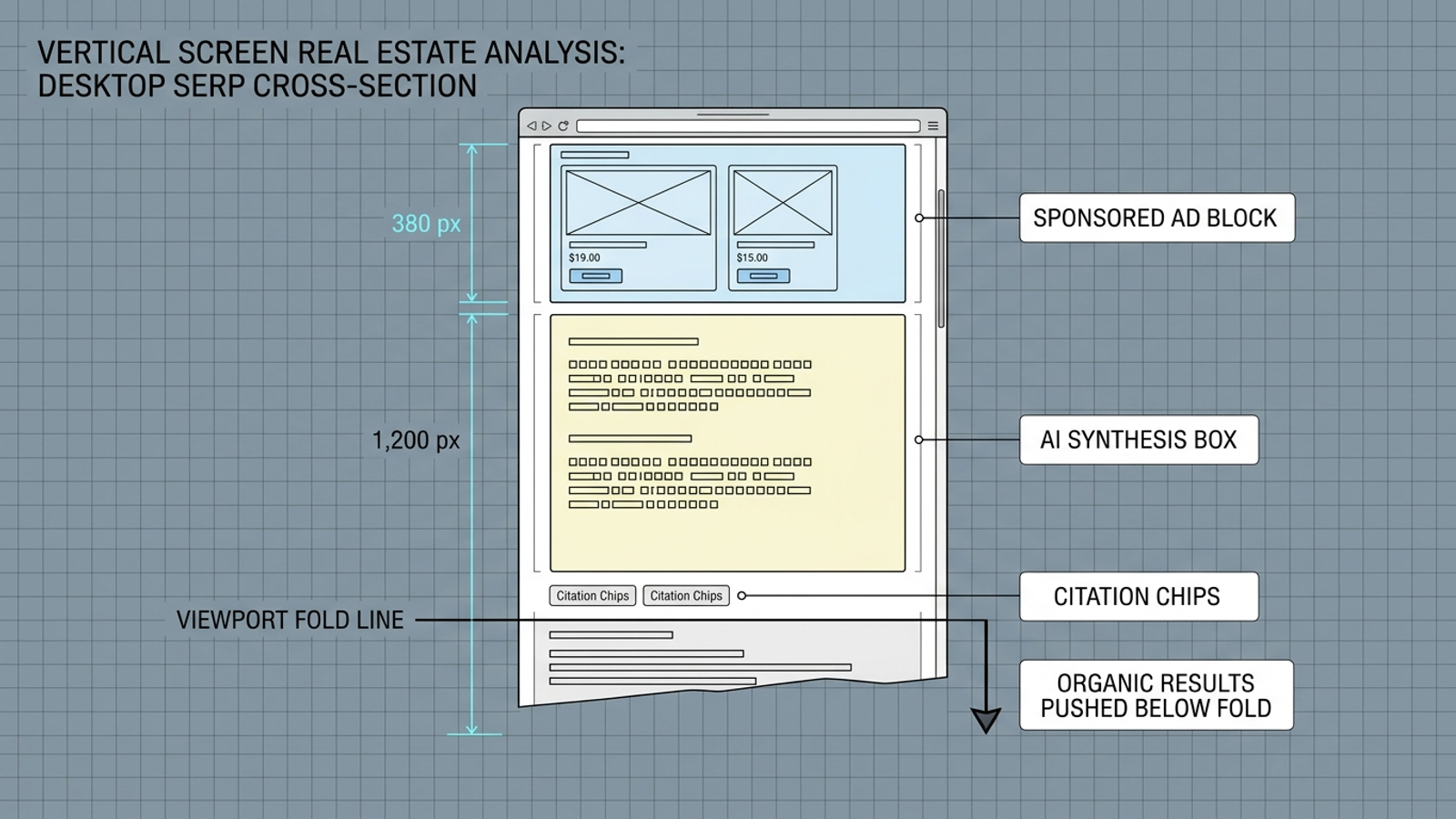
Once an ad claims the top of the page, something else has to move. BrightEdge tracking puts an AI Overview at roughly 1,200 vertical pixels on average before scrolling. On a 1080p desktop screen, that can already push traditional organic rankings out of sight. Put paid units above the synthesis, and prominent citation links compete for what is left of the visible page.
My prediction is not that Google stops citing sources. It is that the visible citation rail gets shorter. A compact group of primary links can still support an answer while leaving room for paid placement; a long carousel consumes attention and space. Additional references could remain available behind an overflow control, but that is not the same thing as appearing before a searcher scrolls.
The clicks are concentrated already. MarGen’s tracking says Google references four to seven sources on research queries, while the top-cited URL receives between 60% and 70% of outgoing citation clicks. That does not prove Google will remove visible links. It does explain why a smaller set of prominent citations could preserve much of the interaction while freeing screen space for the auction.
What would prove me wrong: By October 2027, the mean number of visible primary citation links before the fold on commercial answers remains above three, despite active ad placement. If Google instead makes six or more domains prominent by default on those queries, my screen-space argument has failed. For an organic team, the practical point is blunt: being cited somewhere may not be enough. Position inside the answer matters.
Prediction 3: By October 2027, comparative research will remain mostly ad-light
The auction has a limit: advertisers can stop bidding when a query does not pay. I expect high-intent searches such as “enterprise payroll software pricing” to attract more sponsored space than technical questions such as “heat pump coefficient of performance in subzero temperatures.” Google can offer an ad slot on either query. The buyer still has to find the click worthwhile.
The current signals point to that divide. MarGen’s tracking finds AI Overviews on 62% of comparative queries and 71% of informational searches, versus 34% of direct transactional phrases. That is a distribution of answers, not ads. Separately, SE Ranking’s AI Mode study found ads in 24.33% of answers for queries with CPCs below $2. Again, AI Mode is not an AI Overview; I am using the figure as a signal about low-priced answer inventory, not passing it off as an Overview measurement.
I have argued before that AI Overviews are not, by themselves, what wrecks Google Ads CTR. Bidding blindly on top-of-funnel questions where people have little intent to buy is a better way to waste money. If technical research answers fill with expensive placements that do not convert, performance buyers can pull back bids and negative-match broad terms. Inventory only stays crowded when someone will fund it.
What would prove me wrong: By late 2027, more than 45% of comparative evaluation queries carry paid ads above or within their AI Overviews. If that happens, the auction has found durable demand in a category I expect to remain relatively open. Until then, I would treat these queries as places to earn citations, not as invitations to buy every impression.
Prediction 4: By October 2027, an AI citation visit will deliver at least three times the pipeline value
This is a prediction about value per referral visit, not four times as many clicks or four times the value of every impression. AI answers can reduce the number of people who leave Google at all. A collection of AI search statistics by Malte Landwehr describes zero-click rates of 95% to 99% on conversational and AI search surfaces and a 40% to 61% decline in traditional organic CTR. Pew Research data discussed by Omnibound says only 1% of users click a link inside an AI answer, while 26% leave the results page without clicking anything.
That is bad news if your sole measure is visits. It does not settle the value of the visits that remain. The same Pew data says 70% of consumers partially trust AI summaries, while 75% worry about hallucinations and synthetic bias. A person who clicks a cited source may be checking a claim rather than browsing casually. The answer has given that source a role; the visitor arrives with a reason to inspect it. Landwehr’s figures put an AI citation referral click at four times the pipeline value of an unassisted organic blue-link visit. I am setting my prediction below that reported figure: at least three times the pipeline value per visit by October 2027.

What would prove me wrong: Downstream CRM attribution shows that referral visitors from AI citations deliver less than three times the pipeline value per visit of unassisted organic blue-link visitors. If they convert at or below the standard organic baseline, the stronger claim fails too. Either way, do not judge citations by raw click volume alone. Follow the visits into pipeline.
Prediction 5: By October 2027, buying the ad without earning the citation will cost more
Picture the result: your paid card sits above an AI answer, but the answer cites a competitor. You have bought the first glance. Your competitor supplies the evidence. If that contrast affects the visitor’s decision after the click, higher ad visibility will not necessarily mean cheaper customers.
The gap between paid and cited presence is visible on a related answer surface today. In its study of AI Mode commercial queries, SE Ranking found that 88% of advertisers appearing in answer ads were not cited in the answer; 85% did not hold a page-one organic ranking. Those are AI Mode figures, not AI Overview figures, and I will not use them to claim the same rates in Overviews. They show that buying placement and earning a citation are distinct jobs.
Nor can a team assume its familiar organic ranking will secure the citation. Ahrefs examined 863,000 keyword results pages and four million AI Overview URLs and found that 37.9% of cited URLs came from the top 10 results, 31.2% from positions 11 to 100, and 31.0% from beyond position 100. That makes the operating problem harder: an advertiser can pay for visibility while another domain becomes the answer’s cited source.
My prediction is that accounts holding both positions will achieve at least 20% lower blended customer acquisition cost than advertisers buying the ad without an organic citation. The mechanism is not a mysterious AI bonus. It is the difference between asking a searcher to trust a paid claim alone and appearing in both the paid placement and the answer’s supporting links.
What would prove me wrong: By Q4 2027, blended paid-search CPA remains uncoupled from AI citation share, or accounts with both placements fail to clear that 20% advantage over ad-only advertisers. That would tell me the citation is not affecting paid conversion economics as much as I expect. I would change the bid strategy before defending the theory.
What to do this quarter if I’m right
Start by separating the queries you manage, not by commissioning another report about “AI visibility.” Paid placement and organic citation need one operating plan, because the same answer can contain both.
- Protect high-CPC transactional and commercial investigation terms. Expect more competition for the space above these answers. Run Search and Shopping ads with strict negative-keyword guardrails, and make product specifications and pricing pages clear enough to serve as supporting sources. Do not assume a citation alone will preserve visibility when a sponsored block sits above it.
- Build for comparative and technical research queries. If these remain relatively ad-light, useful comparison tables, raw benchmarking data, and clear technical specifications in semantic HTML give the answer something concrete to cite. Do not pay an auction tax on every research click just because you can bid on the phrase.
- Measure the overlap. Track where you buy the ad, where you earn the citation, and what each combination does to pipeline and acquisition cost. Click totals will not tell you whether the answer helped your ad or handed the supporting evidence to a competitor.
I do not think monthly reporting calls and separate paid and SEO checklists are fast enough for this problem. Auctions reprice by impression; answers and their citations can change. That is why we built groas to run paid ads and organic AI search under one roof, with specialized models working continuously and a human strategist setting the guardrails. I would rather have one system respond to a changed result than discover weeks later that we kept buying the top of an answer that cited someone else.
In October 2027, I will score these five calls against their stated thresholds. For now, the move is simpler: buy the intent worth buying, earn the evidence worth citing, and check whether having both actually lowers what you pay for a customer.